 Template
The ultimate fat loss guide
Everything you need to lose fat and keep your muscle: a free calorie and macro calculator, healthy eating habits, training, cardio, sleep and weight-loss drugs.
Fat loss isn't complicated, but it is easy to overcomplicate. You need a calorie deficit you can live with, enough protein, a training plan that tells your body to keep its muscle, some daily movement, decent sleep, and a way to check you're on track. This guide gives you all of it in one place, with the research behind every number and free tools you can use right on the page. Save it, bookmark it, and come back to it each time you start a new phase.
It's written by Jordan DuBois, the founder of Template Trainer, who has been lifting for 20 years and won the men's open lightweight class at the 2013 NPC Natural Western as a drug-free competitor. Getting stage-lean naturally is about the most demanding fat loss there is, and the same principles that work there work for anyone who wants to lose 10 pounds or 100.
The fat loss plan in 7 steps
- Find your numbers. Use the calorie and macro calculator below to get your daily calories, protein, carbs and fat.
- Aim to lose 0.5 to 1% of your body weight a week. Slower keeps more muscle. Faster is harder to stick to and costs more muscle.
- Eat protein at every meal, about 1.6 to 2.2 g per kg of body weight a day in total.
- Build most meals from whole, minimally processed foods, and plan them ahead. MagicMeals shows each recipe's calories and macros so you can pick meals that fit.
- Lift weights 2 to 4 times a week on a proven program with progressive overload, so the weight you lose is fat and not muscle.
- Move every day: walk, do cardio or circuits, and aim for 150 to 300 minutes of moderate activity a week.
- Sleep 7+ hours, weigh yourself often, and adjust every 2 to 3 weeks based on your average weight, not one morning's number.
The rest of this guide explains each step and how to do it well.
Calculate your calories and macros
This free IIFYM ("if it fits your macros") calculator gives you a daily calorie target and the grams of protein, carbs and fat to hit each day, split into meals. It saves your answers in this browser, so it's ready the next time you check in.
Next step: take your per-meal numbers to MagicMeals and pick recipes that fit them. Then let Template Trainer run your training.
How the calculator works
- Resting burn (BMR) comes from the Mifflin-St Jeor equation, which estimates the calories your body uses at rest from your weight, height, age and sex. It was built from measurements of 498 healthy adults and is one of the most widely used formulas.
- Maintenance calories are your BMR times an activity multiplier, from 1.2 for mostly sitting to 1.9 for a physical job plus hard training. These multipliers are rough. If you're unsure, pick the lower one.
- Your deficit is set from the weekly rate you choose, using about 7,700 kcal per kg of body weight lost. That's a fine starting estimate, but research shows weight loss slows as you get lighter, because a smaller body burns less, so treat the number as a starting point and adjust it as you go.
- It never goes below your BMR. If the rate you pick would take you there, it holds you at your BMR and tells you.
- Protein is 1.6 or 2.2 g per kg of body weight. If your BMI is over 30, it uses the weight you'd be at a BMI of 30 instead, so people with a lot to lose get a realistic target rather than one set by their fat mass.
- Fat is the share of calories you choose (25% is a good default), and carbs fill the rest.
Formulas are estimates for groups of people, and you're one person. The real test is your scale: if your weekly average isn't moving after 2 to 3 weeks, take off another 100 to 200 calories, or add some daily steps.
How fast should you lose fat?
For most people, 0.5 to 1% of body weight a week is the sweet spot. That's about 1 to 2 lb a week for a 200 lb person.
This is the rate recommended for natural bodybuilders getting ready for a show, who need to lose almost all their fat while keeping every bit of muscle they can. In a study of elite athletes who were all lifting weights, the group that lost weight slowly (about 0.7% a week) gained lean mass while dieting, while the group that lost it faster (about 1% a week) didn't.
| Your situation | Good rate | Example for 200 lb (91 kg) |
|---|---|---|
| Already lean, or new to dieting and want to keep muscle | 0.5% a week | 1 lb (0.45 kg) a week |
| Most people | 0.75% a week | 1.5 lb (0.7 kg) a week |
| A lot to lose, or a short, focused push | 1% a week | 2 lb (0.9 kg) a week |
Fast diets aren't just harder on muscle. They're harder to stick to, and sticking to it is the whole game. Pick the rate you can keep up for months, not the one that looks best for the first week.
What is IIFYM (flexible dieting)?
IIFYM stands for "if it fits your macros". Instead of a list of banned foods, you get daily targets for calories, protein, carbs and fat, and any food can fit if it fits those numbers. It's how many physique athletes diet, and it works because it respects the most important rule of fat loss: the calorie deficit.
The type of diet matters much less than people think. In the DIETFITS trial, 609 adults were randomly assigned to a healthy low-carb or a healthy low-fat diet for a year. Both groups lost about the same amount of weight, about 13 lb on average, and neither diet worked better for any particular genetic or insulin profile. Low-carb, low-fat, keto or Mediterranean: the one you can stick to is the best one for you.
But "any food can fit" doesn't mean every food helps equally. What you eat changes how much you eat. In a tightly controlled NIH study, 20 adults lived in a clinic for a month and could eat as much as they wanted. On an ultra-processed diet they ate about 500 more calories a day and gained about 2 lb in two weeks. On a minimally processed diet with the same calories, sugar, fat, fiber and macros on offer, they lost about the same amount. Same freedom, very different results.
So the best approach is flexible, but mostly whole foods: hit your numbers, build most meals from minimally processed food, and leave room for the foods you love so the plan doesn't break.
Healthy eating habits that make fat loss easier
Hitting your numbers is much easier when your habits do the work for you. These are the ones that matter most.
Put protein at the center of every meal
Protein protects your muscle in a deficit and is the most filling of the macros. A meta-analysis of 49 studies put the amount that maximizes muscle gains from lifting at about 1.6 g per kg a day, with some people benefiting from up to about 2.2 g. For lean lifters in a deficit, a systematic review suggests even more, about 2.3 to 3.1 g per kg of lean mass. Spread it over 3 to 5 meals: chicken, fish, lean beef, eggs, Greek yogurt, cottage cheese, tofu, tempeh, beans and lentils, or a protein shake when you're short.
Build a fat-loss plate
A simple way to build a meal without weighing everything:
- Half the plate: vegetables or salad. Lots of volume, few calories, plenty of fiber.
- A quarter: a palm or two of lean protein.
- A quarter: a fist of carbs, like potatoes, rice, oats, whole-grain bread or fruit.
- A thumb or two of fats: olive oil, nuts, avocado or cheese.
Adjust the carb and fat portions up or down to fit your targets from the calculator.
Plan meals before you're hungry
Most diets fail at 7 pm on a Tuesday when there's nothing ready. Plan the week's meals ahead, shop from a list, and cook in batches so the easy choice is the right one. That's exactly what MagicMeals is for (see the next section).
Watch the calories you drink
Soda, juice, fancy coffees and alcohol add up fast and don't fill you up. Swap to water, sparkling water, black coffee, tea or diet drinks. If you drink alcohol, count it, and plan for it.
Keep the foods you love, on purpose
Fit a treat into your day instead of banning it. A planned dessert you count is a lot better for your diet than a "cheat day" that wipes out a week's deficit.
Track for a while, even if you don't track forever
People who keep track of what they eat and weigh themselves regularly lose more weight. A systematic review of 22 studies found a significant link between self-monitoring and weight loss again and again. Track closely for the first few weeks to learn what your portions really look like, then decide how much tracking you need.
Plan your meals in MagicMeals
MagicMeals is Jordan's meal planning and recipe app, and it fits this guide's approach: plan meals that fit your numbers, then cook them.
- Save recipes from anywhere. Paste a link from Instagram, TikTok, YouTube or a recipe site and it saves the recipe for you.
- See the macros for every recipe. Its nutrition calculator uses USDA data to show calories, protein, carbs and fat per serving, so you can see at a glance which meals fit your per-meal targets.
- Track what you eat in its food diary, and turn your recipes into an aisle-sorted shopping list.
- Plan your meals for the week and batch cook them.
How to use it with the calculator above:
- Note your per-meal targets, or press Copy my targets.
- In MagicMeals, save a handful of high-protein recipes you'd actually enjoy, and check each one's calories and protein per serving.
- Pick the ones that fit your per-meal numbers (or change the serving size until they do), plan them across the week, and build your shopping list.
The free plan includes up to 25 recipes, the shopping list and the food diary. Meal planning is part of the paid plan, which has a free trial. Check MagicMeals for current details.
Disclosure: MagicMeals and Template Trainer are both made by Jordan DuBois, the author of this guide.
Lift weights to keep your muscle
When you lose weight, some of it is lean mass, not fat. In people with overweight or obesity, lean mass typically makes up about 20 to 30% of what comes off, and in leaner people it can be more than 35%. Lifting weights is the strongest signal you can send your body to hold on to muscle. A review on preserving muscle during weight loss found that resistance exercise helps keep muscle mass and also improves strength, and recommended adequate protein plus more activity, especially resistance exercise, as part of any weight-loss plan.
What that looks like in practice:
- Train each major muscle about twice a week, with 2 to 4 sessions in total.
- Keep the weights heavy. A deficit is the time to keep your strength, not to switch to light "toning" sets. If your lifts hold steady while the scale drops, you're losing fat, not muscle.
- Follow a proven program instead of making it up each session. Our guide on how to choose a workout program helps you pick one for your schedule and experience.
- Keep progressing where you can. Beginners can often still add weight while losing fat. More advanced lifters may just hold their numbers, which is a win.
- Take a deload when you need it. Recovery is harder in a deficit.
How Template Trainer helps
Template Trainer is a free workout app that runs your program for you. Pick one of 34 free workout templates, like StrongLifts 5x5, GZCLP, PHUL, the Reddit PPL or 5/3/1, and the app sets every session's weights from the program's own progression rules, logs every set, and shows whether your strength is holding up while you diet.
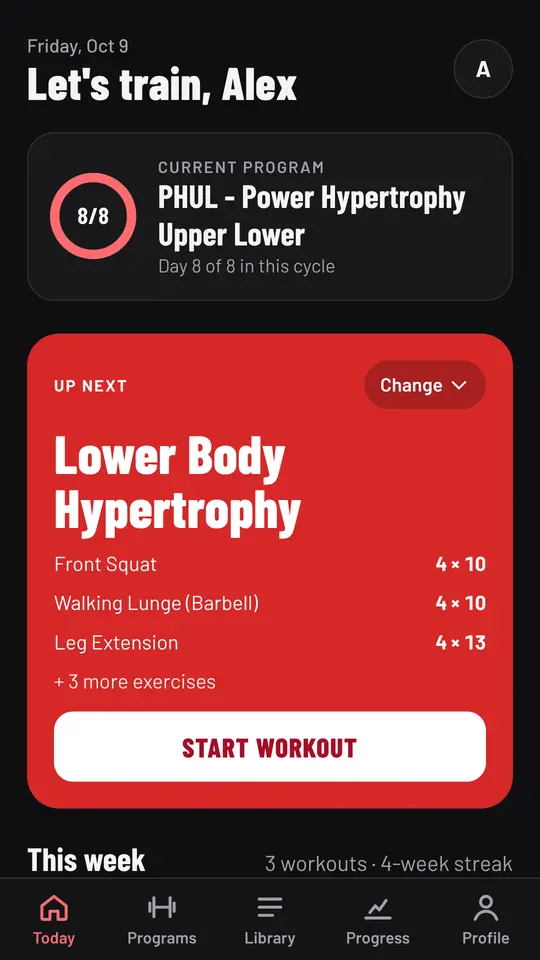
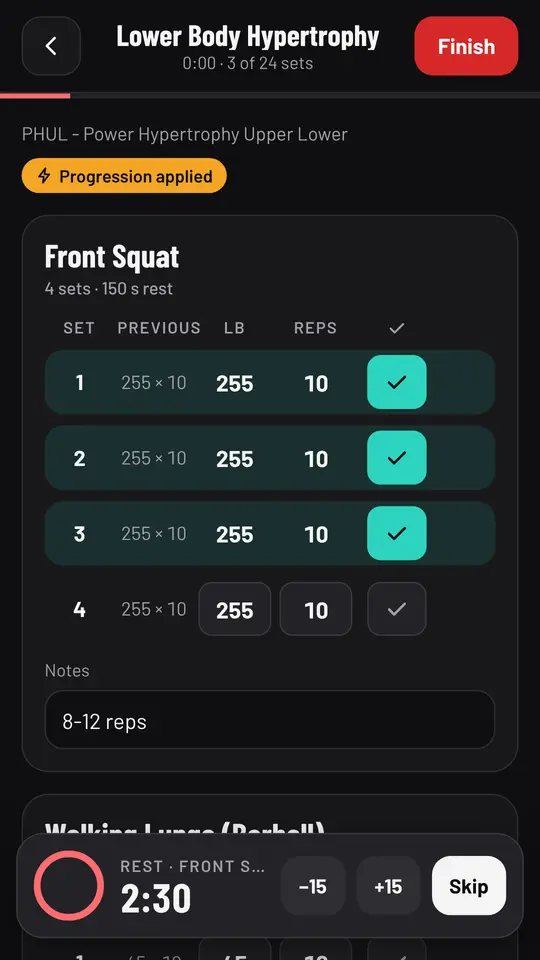
You can also log your bodyweight in Profile, and the Relative strength card on Progress shows your lifts as a multiple of your bodyweight, which should rise as you lean out.
Cardio, circuits and daily steps
Cardio isn't what makes you lose fat (the deficit does), but it makes the deficit easier and it's great for your health. The World Health Organization recommends that adults get 150 to 300 minutes of moderate activity (or 75 to 150 minutes of vigorous activity) a week, plus muscle-strengthening work on 2 or more days.
Don't underestimate everyday movement
The calories you burn outside the gym, walking, standing, fidgeting and doing chores, add up. In a classic overfeeding study, people who gained the least fat were the ones whose everyday movement went up the most, with the change in this non-exercise activity ranging from a drop of about 100 calories to an increase of almost 700 calories a day. A daily step goal is one of the easiest ways to keep yours up while you diet, because hunger and tiredness tend to make you move less without noticing.
Use circuits for efficient conditioning
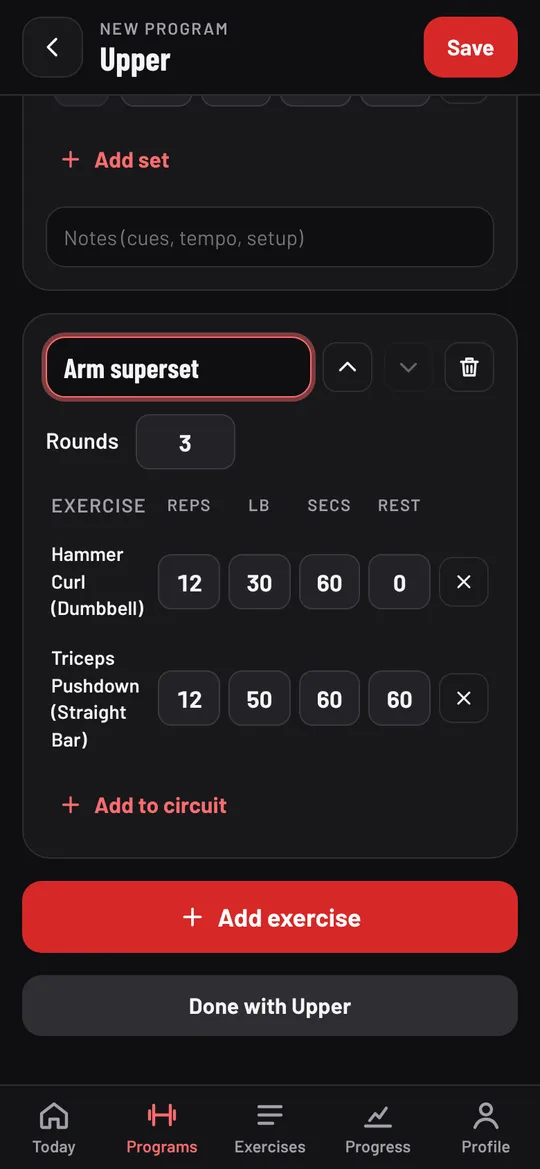
Circuits combine strength and conditioning: you move from one exercise to the next with little rest, so your heart rate stays up. They're a time-efficient way to add conditioning on top of your main lifting. Here's a free timer to run one right now. Pick a preset or type in your own exercises.
For ready-made circuits, see how to do a circuit workout, and for short, hard intervals use the Tabata timer. In Template Trainer, a circuit can be part of your program, with the same timer built into the workout and every round logged.
Let AI build your fat loss program
If you'd rather not build a program yourself, you can have an AI assistant like Claude build one for you and add it straight to your Template Trainer account. The app has an MCP server, the standard way AI apps connect to other tools, and the assistant works from the app's exercise library, checks the weekly sets for every muscle, shows you the plan, and only saves it once you agree. It can add programs, but it can't change or delete anything you already have.
- In Template Trainer, open Profile, find AI assistants, and make a connection key.
- Connect your AI app with the server address and key shown there. Claude Code takes a single copy-and-paste command, and apps like Claude Desktop can connect through a small helper.
- Ask for what you want. For example:
Build me a 4-day upper/lower program for fat loss. I train in a commercial gym for about 60 minutes. Keep the main lifts heavy at 5 to 8 reps, give every major muscle 10 to 16 sets a week, and finish two of the days with a 3-round conditioning circuit of 40 seconds work and 20 seconds rest.
Review the plan, ask for changes, and once it's saved it shows up in your Programs, ready to run. To learn the building blocks yourself, see how to create a workout program.
Sleep: the fat loss multiplier
Sleep is where a lot of diets quietly go wrong. In a controlled study, 10 adults dieted for two weeks twice, once with 8.5 hours in bed a night and once with 5.5 hours. They ate the same calories each time, but with short sleep the share of weight lost as fat fell by 55%, and the loss of fat-free mass rose by 60%. Less sleep meant more of the weight came from the wrong place.
Aim for 7 or more hours a night with a regular bedtime. If your sleep, mood or training falls apart during a diet, that's a sign your deficit is too big. If you track sleep with a wearable, you can even look for links between your workouts, sleep and nutrition in your own data.
Track your progress and adjust
Daily weight jumps around with water, salt, carbs and digestion, so a single weigh-in tells you very little. Do this instead:
- Weigh yourself most mornings, after the bathroom and before eating, and look at the weekly average.
- Compare the averages every 2 to 3 weeks. If you're losing within your target rate, change nothing.
- If the average stalls for 2 to 3 weeks, take off 100 to 200 calories a day, or add 2,000 to 3,000 daily steps, then check again.
- Track your strength. If your lifts are holding or climbing, the weight you're losing is mostly fat.
- Take photos and a waist measurement every few weeks. They show changes the scale misses.
Expect fat loss to slow over time. A smaller body burns fewer calories, so the same intake gives you a smaller deficit. One modelling study estimated that for an average adult with overweight, only about half of the total weight change from a lasting change in calories happens in the first year. That's why you re-run the calculator as you lose weight, rather than cutting calories at the first slow week.
Weight loss drugs: GLP-1s in brief
Prescription GLP-1 medications such as semaglutide (Wegovy, Ozempic) and tirzepatide (Zepbound, Mounjaro) reduce appetite and have produced large weight losses in trials:
- Semaglutide (STEP 1): about 14.9% average weight loss after 68 weeks, compared with 2.4% on placebo, with both groups also given a lifestyle program.
- Tirzepatide (SURMOUNT-1): about 15 to 21% average weight loss after 72 weeks depending on the dose, compared with about 3% on placebo.
- Stopping the drug: a year after people stopped semaglutide, they had regained about two-thirds of the weight they lost.
They're a real option for many people, but they don't replace the habits in this guide. Part of the weight lost on them is lean mass, so lifting weights and eating enough protein matter even more on a GLP-1, and those habits are what you keep if you ever stop. For the full picture, including how much muscle people lose, how to train on them and which supplements are worth it, read how to keep your muscle on GLP-1s and other weight-loss drugs. Talk to your doctor about whether a medication is right for you.
Your fat loss toolkit
Everything you need, in one list to bookmark:
- Calorie and macro calculator: on this page.
- Meal planning: MagicMeals, for recipes with their calories and macros, meal plans and shopping lists.
- Workout programs: 34 free workout templates in Template Trainer, with every session's weights set for you.
- An AI-built program: connect an AI assistant to build your program for you.
- Conditioning timers: the circuit timer and the Tabata timer.
- Keep progressing: progressive overload and how to deload.
- On a GLP-1: how to keep your muscle on weight-loss drugs.
Frequently asked questions
How many calories should I eat to lose fat?
Start about 300 to 1,000 calories a day below your maintenance, enough to lose 0.5 to 1% of your body weight a week. The calculator on this page works out both numbers for you. Then adjust from your weekly average weight after 2 to 3 weeks.
How much protein do I need to lose fat and keep muscle?
About 1.6 to 2.2 g per kg of body weight a day (roughly 0.7 to 1 g per lb), spread over your meals. Lean lifters in a bigger deficit may benefit from the higher end. If you have a lot of weight to lose, base it on a goal weight instead of your current one.
What does IIFYM mean?
"If it fits your macros." You get daily targets for calories, protein, carbs and fat, and any food can fit as long as the day adds up. It works best when most of your food is minimally processed, which keeps you fuller on the same calories.
Is cardio or weight training better for fat loss?
You need both, for different reasons. Your calorie deficit drives fat loss, weight training makes sure the weight you lose is fat rather than muscle, and cardio and daily steps make the deficit easier and improve your health. If you only have time for one, lift and walk.
Can I lose fat and build muscle at the same time?
Often, yes, especially if you're new to lifting, coming back after a break, or carrying more body fat. Eat plenty of protein, lose weight slowly and keep progressing on a good program. Experienced, lean lifters usually do better aiming to keep muscle while dieting, then building it afterward.
Why did my weight loss stall?
Usually because your maintenance calories dropped as you got lighter, you're moving less without noticing, or portions have crept up. Check your weekly averages over 2 to 3 weeks, re-run the calculator with your new weight, and take off 100 to 200 calories or add some daily steps. Water retention can also hide fat loss for a week or two.
Do I need weight loss drugs to lose fat?
No. Most people can lose fat with the habits in this guide. GLP-1 medications can help people with obesity or weight-related health conditions, and you should decide with your doctor. If you do take one, keep lifting and eating enough protein to protect your muscle.
Is this guide written by a qualified coach?
It's written by Jordan DuBois, who has 20 years of lifting experience, won the men's open lightweight class at the 2013 NPC Natural Western as a natural bodybuilder, and holds degrees in biology and applied mathematics from Arizona State University. Every number on this page is backed by the research listed below. Read Jordan's full bio.
Sources
- Helms, Aragon and Fitschen (2014), Evidence-based recommendations for natural bodybuilding contest preparation: nutrition and supplementation, Journal of the International Society of Sports Nutrition
- Helms et al. (2014), A systematic review of dietary protein during caloric restriction in resistance trained lean athletes: a case for higher intakes, International Journal of Sport Nutrition and Exercise Metabolism
- Garthe et al. (2011), Effect of two different weight-loss rates on body composition and strength and power-related performance in elite athletes, International Journal of Sport Nutrition and Exercise Metabolism
- Morton et al. (2018), A systematic review, meta-analysis and meta-regression of the effect of protein supplementation on resistance training-induced gains in muscle mass and strength in healthy adults, British Journal of Sports Medicine
- Mifflin et al. (1990), A new predictive equation for resting energy expenditure in healthy individuals, American Journal of Clinical Nutrition
- Hall et al. (2011), Quantification of the effect of energy imbalance on bodyweight, The Lancet
- Gardner et al. (2018), Effect of Low-Fat vs Low-Carbohydrate Diet on 12-Month Weight Loss in Overweight Adults (DIETFITS), JAMA
- Hall et al. (2019), Ultra-Processed Diets Cause Excess Calorie Intake and Weight Gain: An Inpatient Randomized Controlled Trial of Ad Libitum Food Intake, Cell Metabolism
- Cava, Yeat and Mittendorfer (2017), Preserving Healthy Muscle during Weight Loss, Advances in Nutrition
- Bull et al. (2020), World Health Organization 2020 guidelines on physical activity and sedentary behaviour, British Journal of Sports Medicine
- Levine, Eberhardt and Jensen (1999), Role of nonexercise activity thermogenesis in resistance to fat gain in humans, Science
- Nedeltcheva et al. (2010), Insufficient sleep undermines dietary efforts to reduce adiposity, Annals of Internal Medicine
- Burke, Wang and Sevick (2011), Self-monitoring in weight loss: a systematic review of the literature, Journal of the American Dietetic Association
- Wilding et al. (2021), Once-Weekly Semaglutide in Adults with Overweight or Obesity (STEP 1), New England Journal of Medicine
- Jastreboff et al. (2022), Tirzepatide Once Weekly for the Treatment of Obesity (SURMOUNT-1), New England Journal of Medicine
- Wilding et al. (2022), Weight regain and cardiometabolic effects after withdrawal of semaglutide: The STEP 1 trial extension, Diabetes, Obesity and Metabolism
About the author

Jordan DuBois has been lifting for 20 years and won the men's open lightweight class at the 2013 NPC Natural Western in Arizona as a natural, after placing 2nd at the 2011 NPC Western Regional. Jordan holds summa cum laude degrees in applied mathematics and biology from Arizona State University, and founded Template Trainer to run proven programs the way their authors wrote them.